
Introduction: Why Domain Appraisal Matters in 2026
The domain market has evolved faster in the last three years than in the previous decade.
AI-generated domains, inconsistent marketplace pricing, unreliable automated tools, and aggressive broker valuations have made it harder than ever to know what a domain is really worth. In this environment, domain appraisal is no longer optional. It’s a required skill for anyone buying, selling, or investing in domain names.
A proper domain appraisal helps you:
avoid overpaying for weak domains
avoid selling premium names too cheaply
spot undervalued opportunities
evaluate auctions and drop-catch names
understand real buyer demand
negotiate with confidence
This pillar guide explains everything about domain appraisal—what it is, why it matters, how it’s done, how tools work, and when to use professional appraisal services like DomainVerdict.
Let’s start with the basics.
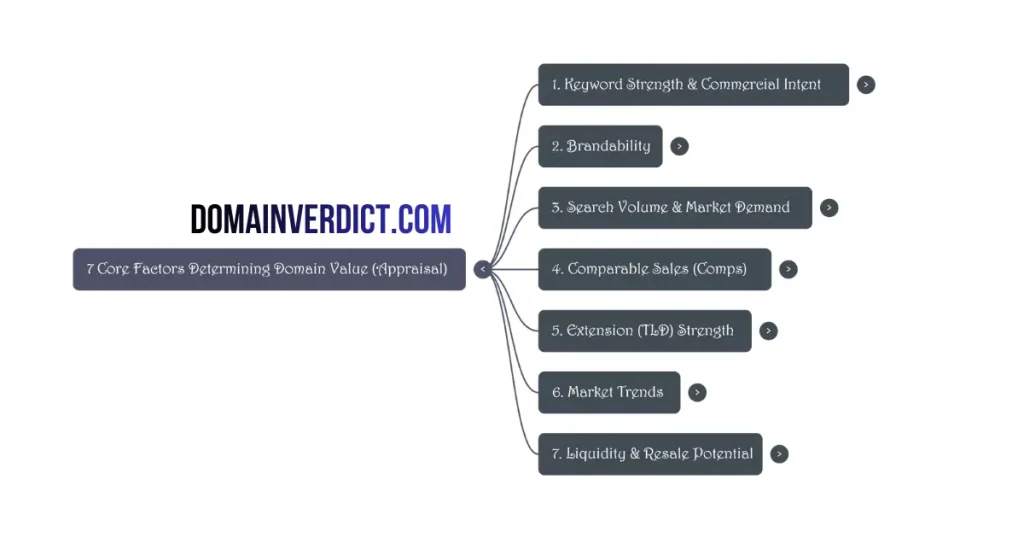
Table of Contents
What Is Domain Appraisal?
A domain appraisal is an evaluation of the market value of a domain name based on keyword strength, brandability, comparable sales, industry trends, extension quality, and liquidity.
In simple terms:
A proper domain appraisal is NOT:
- the price the seller wants
- the number a marketplace displays
- an AI-generated guess
- a random comparable from an unrelated domain sale
A real appraisal requires data + market logic + human judgment.
This is where most beginners go wrong — they rely on automated tools or personal feelings instead of actual valuation criteria.
Why Domain Appraisal Matters (Beginner + Investor Perspective)
Domain appraisal is critical because:
1. Marketplaces inflate prices
Anyone can list a $300 domain for $30,000.
That doesn’t make it valuable.
2. AI appraisal tools are inconsistent
Tools often disagree by thousands of dollars.
3. Domain value shifts with trends
AI, fintech, cloud, wellness, sustainability — all trend-driven industries.
4. Investors need clarity before buying or bidding
A wrong appraisal can destroy ROI instantly.
5. End-users overpay without guidance
Proper domain appraisal prevents costly mistakes.
This is why 2025 investors rely increasingly on professional, investor-grade domain appraisals.
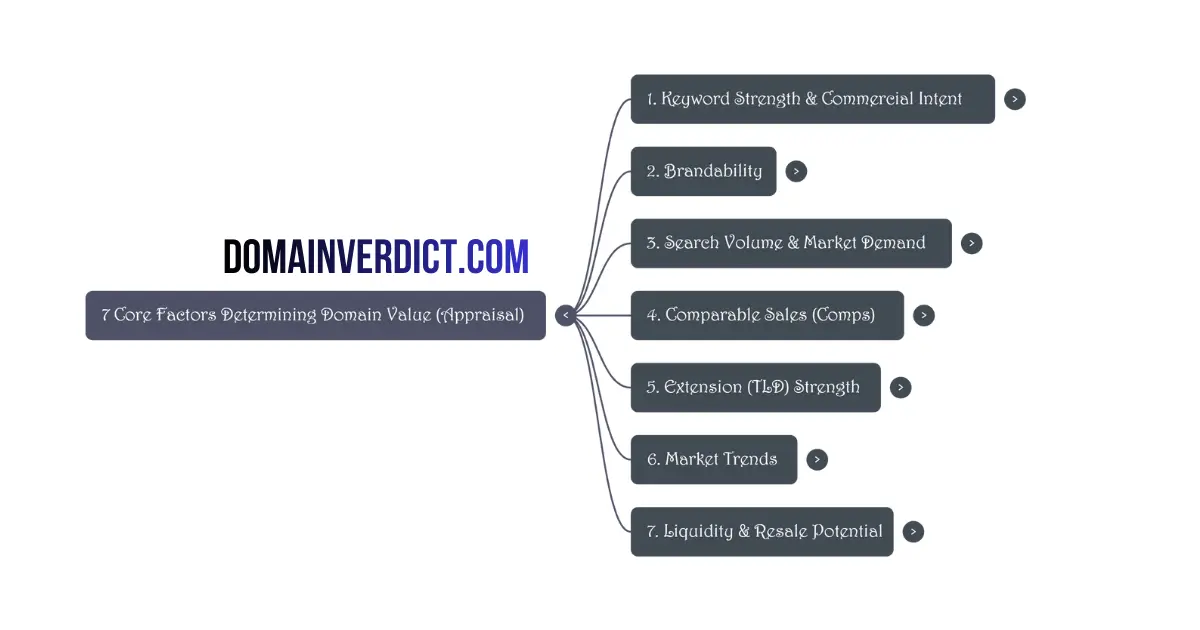
The 7 Core Factors That Determine a Domain’s Value
Every proper domain appraisal—manual or automated—comes from analyzing seven fundamental elements.
1. Keyword Strength & Commercial Intent
Keywords with high business value increase domain value dramatically.
Examples of high-value keywords:
- loan / lending
- crypto / pay / bank
- health / wellness
- ai / tech / cloud
- data / analytics
Commercial intent = the buyer can make money using the domain.
Domains with buyer intent ALWAYS outperform domains with informational keywords.
2. Brandability
Brandability often beats exact-match keywords.
A strong brandable domain is:
- easy to spell
- easy to pronounce
- short
- memorable
- visually clean
- trademark-safe
Brandable domains like Coinbase, Stripe, Zoom, Canva, Shopify prove this.
3. Search Volume & Market Demand
Search volume reveals how many people want the keyword.
Industry demand reveals how much companies want names in that category.
High demand categories in 2025:
- AI
- SaaS
- cybersecurity
- cloud infrastructure
- green tech
- remote work
- fintech
High demand = higher valuation.
4. Comparable Sales (Comps)
Comps are the foundation of all serious domain appraisal.
Correct comps must match:
- keyword
- structure
- length
- TLD
- industry
- brandability category
Bad comps lead to bad valuations.
5. Extension (TLD) Strength
Not all extensions are equal.
.COM is still the king.
95% of high-value sales happen in .com.
Strong TLDs:
.com, .de, .co.uk, .ai, .io
Weak TLDs:
Random new gTLDs
Niche novelty TLDs
Extensions with no adoption
DomainVerdict does NOT overvalue weak TLDs the way automated tools do.
6. Market Trends
Trends shape valuations:
- AI domains exploded from 2022–2025
- NFT domains collapsed after 2022
- “Meta” peaked in 2021 and crashed a year later
Trend analysis prevents overpaying on hyped niches.
7. Liquidity & Resale Potential
Liquidity = how quickly a domain can sell in the investor market.
High liquidity domains:
- short (4–6 characters)
- strong brandables
- premium keywords
- solid .coms
Low liquidity domains:
- long phrases
- vague concepts
- niche extensions
- informational keywords
Liquidity determines how safe the investment is.
Automated Domain Appraisal Tools vs Professional Appraisal
Automated Tools (GoDaddy, EstiBot, AI bots)
Pros:
- fast
- free
- useful for rough estimation
Cons:
- misunderstanding brandability
- comparing irrelevant comps
- fake inflation
- treating weak TLDs as valuable
- unable to judge buyer demand
- inconsistent
- cannot determine liquidity
- cannot provide an investor verdict
Automated tools are indicators—not valuations.
Professional Domain Appraisal (DomainVerdict)
Professional appraisal includes:
- keyword analysis
- comparable sales
- brandability scoring
- liquidity forecast
- category demand assessment
- trend weighting
- buy / sell / hold verdict
- valuation certificate
A human-reviewed appraisal gives reliable, consistent results based on real market logic.
This is what DomainVerdict delivers.
Types of Domain Appraisal
1. Automated Appraisal
Good for quick checks.
Not accurate enough for real buying/selling.
2. Expert Manual Appraisal
The most accurate method.
Combines comps, brandability, keyword logic, and industry knowledge.
3. Broker Appraisal
Often inflated to secure listings.
Not reliable for true value.
4. Marketplace Internal Appraisal
Useful only for platform pricing consistency.
Domain Appraisal Pricing (2025 Market Rates)
Industry pricing ranges:
- Free → AI tools
- $10–$30 → manual appraisal startups
- $50–$300 → brokers
- $500–$1,500 → corporate valuation agencies
DomainVerdict’s pricing fits the realistic range:
- $9.99 Essential
- $14.99 Standard
- $29.99 Premium
Transparent. Investor-friendly.
No hype. No inflated values.
When Should You Get a Domain Appraisal?
- before buying a domain over $200
- before bidding at auctions
- before listing a domain
- before negotiating with a buyer
- before dropping domains
- when you compare two names
- when building a portfolio
A small appraisal prevents big losses.
Domain Appraisal Examples Section
Example 1: CRTR.com
Type: 4-letter .com
CRTR.com is a strong consonant-heavy 4L domain with multiple possible interpretations.
It can stand for Creator, Cater, Curator, Carter, or brand-specific initials.
Strengths:
- Premium 4L .com
- Strong acronym potential
- High liquidity in domainer market
- Fits fintech, SaaS, creator economy, logistics, media, or enterprise naming
Weaknesses:
- Non-pronounceable pattern limits mass-market brandability
- Best suited for corporate acronym usage
Comparable Sales:
- Non-pronounceable LLLL.com acronyms consistently sell between $1,200–$8,000
- Top-tier acronym 4Ls sell significantly higher
Valuation:
- Wholesale: $700–$1,200
- Investor: $1,500–$3,500
- End user: $4,000–$12,000+
Example 2: DCTM.com
Type: 4-letter .com
DCTM.com reads like an enterprise acronym — ideal for corporate, government, tech, or B2B sectors. 4-letter “cluster” acronyms like this are consistently in demand.
Strengths:
- Clean corporate acronym
- Strong pattern (no awkward letter combos)
- Perfect for digital content management, consulting firms, IT services, data companies
- Very high liquidity in investor markets
Weaknesses:
- Not brandable for consumer-facing companies
- Depends heavily on acronym meaning
Comparable Sales:
- LLLL.com corporate acronyms often sell in the $2,000–$10,000 range
- Strong patterns and industry fit push values higher
Valuation:
- Wholesale: $800–$1,400
- Investor: $1,800–$4,000
- End user: $5,000–$15,000+
Example 3: Pandaa.com
Type: two-word style brandable (double-a ending)
Pandaa.com is a friendly, memorable brandable with clear emotional appeal.
The double-A ending gives it a playful and modern feel without losing brand potential.
Strengths:
- Strong brandability
- Memorable and visually clean
- Perfect for e-commerce, design, lifestyle, pet niche, entertainment, or kid-focused brands
- “Panda” is a beloved global symbol → easy branding
Weaknesses:
- Misspelling of “Panda” (intentional brandable) means buyers must accept the stylization
- Values depend heavily on end-user appeal
Comparable Sales:
- Brandable animal-related names have sold in the $2,000–$20,000 range depending on niche
- Double-letter brandables trend well with startups
Valuation:
- Wholesale: $250–$450
- Investor: $500–$1,200
- End user: $2,000–$10,000+
Where to Compare Premium Brandable Domains
Looking for high-quality comparator domains?
Explore curated premium brandables at:
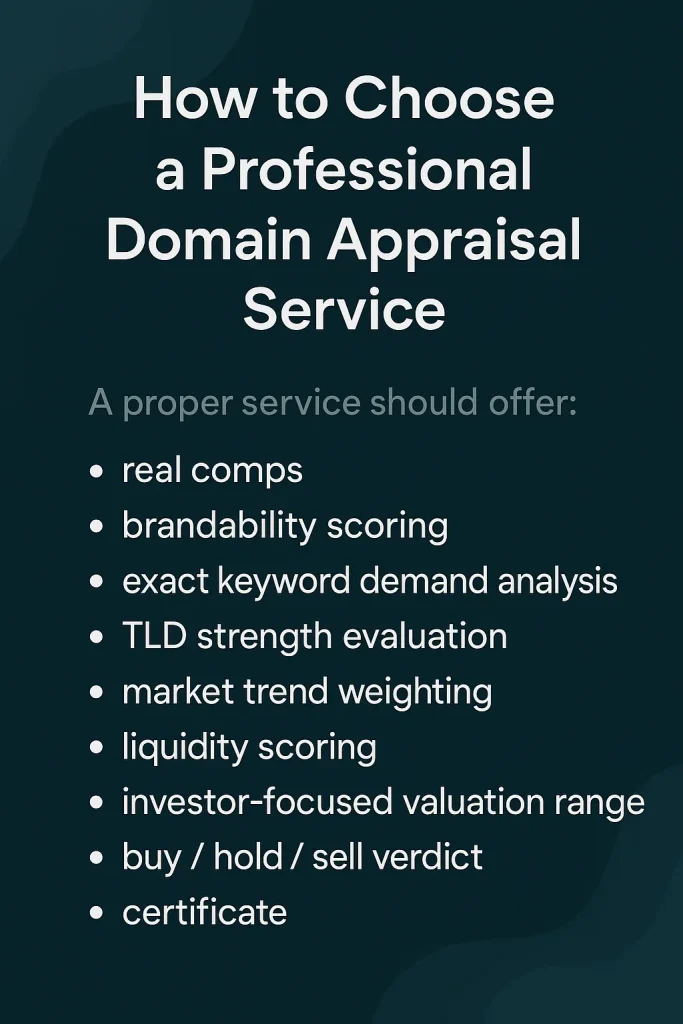
How to Choose a Professional Domain Appraisal Service
A proper service should offer:
- real comps
- brandability scoring
- exact keyword demand analysis
- TLD strength evaluation
- market trend weighting
- liquidity scoring
- investor-focused valuation range
- buy / hold / sell verdict
- certificate
DomainVerdict provides all of these at investor-friendly pricing.
What is domain appraisal?
A domain appraisal determines the real-world value of a domain using keyword strength, comps, and brandability.
How much does domain appraisal cost?
Most professional appraisals range from $10–$30.
DomainVerdict starts at $9.99.
Are automated appraisal tools accurate?
They are useful for rough checks but not accurate enough for buying or selling decisions.
Can I appraise my domain myself?
Yes — by analyzing keywords, comps, trends, demand, and brandability.
What increases domain value?
Short length, strong keywords, .com extension, brandability, and commercial demand
Final Verdict: Why Domain Appraisal Is Essential in 2026
Domain appraisal in 2026 is no longer guesswork or hype.
It’s a systematic evaluation based on:
- keyword logic
- brandability
- comps
- trends
- extension quality
- buyer demand
- liquidity
Investors who understand domain appraisal outperform the market.
Investors who rely on automated tools or marketplace prices lose money.
If you want a fast, accurate, investor-grade appraisal:
➡️ Check out Domain Appraisal at DomainVerdict.com