
If you’re trying to buy a domain and feel confused, you’re not doing anything wrong.
Most people mix up domain appraisal vs pricing, and the internet does a fantastic job of making that confusion worse.
You’ll see:
- appraisal numbers that look precise but feel random
- asking prices that seem detached from reality
- “deals” that don’t feel like wins afterward
The mistake most buyers make is assuming appraisal and pricing are the same thing.
They’re not even close.
Table of Contents
Domain Appraisal vs Pricing: Two Different Questions
The cleanest way to understand domain appraisal vs pricing is this:
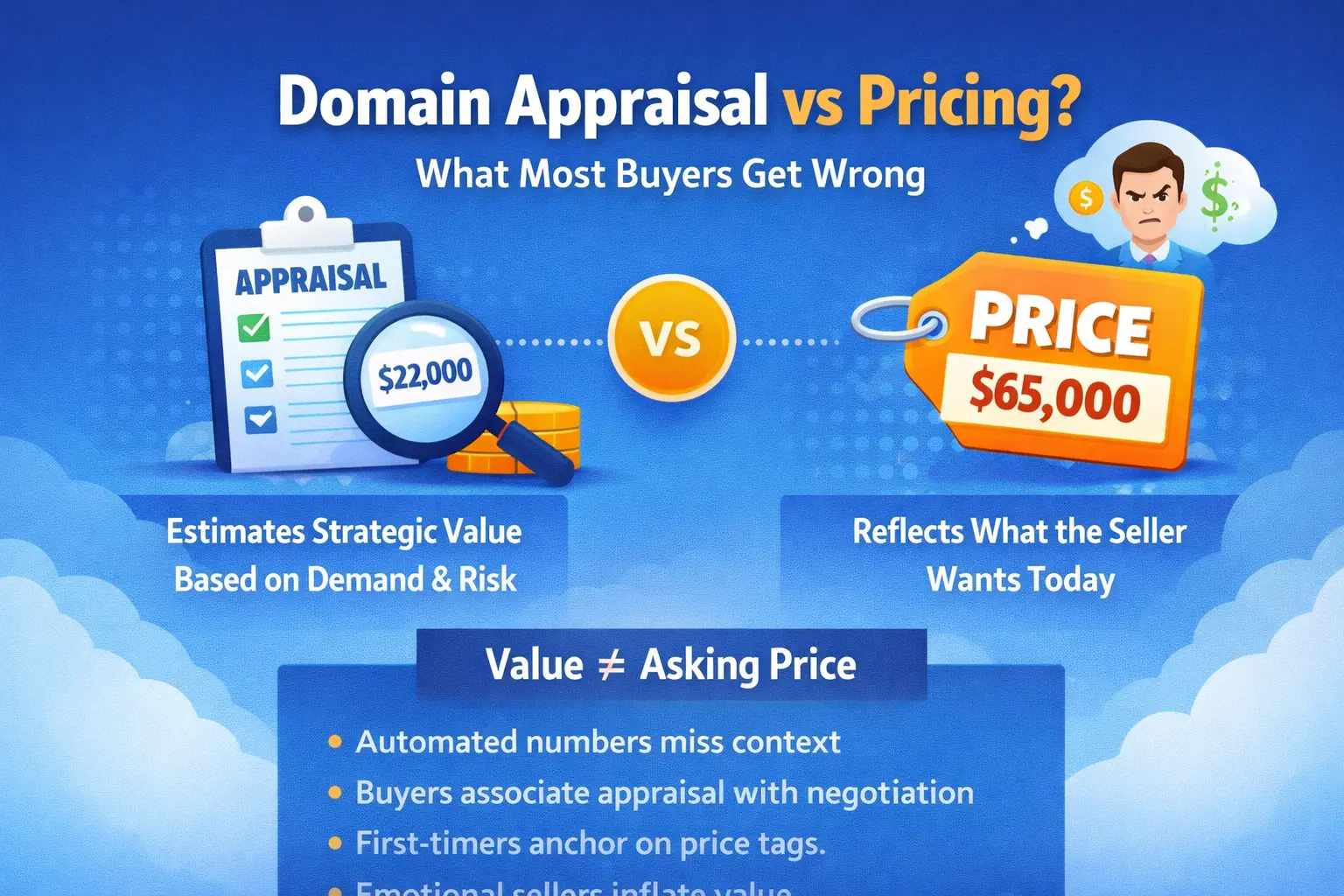
- Domain appraisal asks: What is this domain realistically worth in context?
- Domain pricing asks: What does the seller want right now?
Those are different questions, with different incentives behind them.
An appraisal is about decision-making.
Pricing is about positioning and leverage.
Confusing the two is how buyers overpay or hesitate at the wrong moment.
What a Domain Appraisal Is Actually For
A domain appraisal is not meant to tell you:
- what you should pay
- what the seller will accept
- what the domain will sell for tomorrow
Its job is simpler and more useful.
In the domain appraisal vs pricing equation, appraisal exists to answer:
- Is this domain strategically strong or just convenient?
- Does it reduce long-term risk?
- Is this name defensible if the company grows?
- Would I regret not owning this later?
A good appraisal gives you clarity, not a price tag.
What Domain Pricing Is Really About
Pricing has very little to do with intrinsic value.
Pricing is influenced by:
- the seller’s patience
- portfolio strategy
- emotional attachment
- financial pressure
- negotiation posture
In the domain appraisal vs pricing mismatch, pricing is often inflated or distorted because sellers anchor high to protect optional upside.
That doesn’t automatically make the price wrong.
It makes it contextual.
Buyers who treat pricing as truth usually end up negotiating against themselves.
Why Automated Tools Make This Worse
Automated tools collapse domain appraisal vs pricing into a single misleading number.
They try to simulate value by averaging:
- past sales
- keyword data
- length
- extension patterns
What they cannot see:
- buyer urgency
- internal company dynamics
- board-level risk tolerance
- replacement cost psychology
So buyers walk away thinking:
That gap isn’t a scam.
It’s the space where judgment lives.
The Buyer Mistake That Costs the Most
Here’s the most common buyer mistakes in the domain appraisal vs pricing confusion:
They reject good domains because the price feels high, without understanding the cost of not owning it.
What they don’t price in:
- future rebrands
- defensive purchases later at higher prices
- brand dilution
- lost leverage after funding
A domain can be “overpriced” today and still be a smart buy.
That sounds uncomfortable, but it’s true.
When Appraisal Should Matter More Than Price
In the domain appraisal vs pricing decision, appraisal should outweigh price when:
- the domain defines your category
- alternatives are weak or awkward
- you’re pre-funding or mid-transition
- the name affects trust or conversion
In these cases, price becomes a secondary variable.
Risk reduction becomes the primary one.
This is where experienced buyers slow down instead of rushing to negotiate.
When Pricing Should Override Appraisal
There are times when pricing matters more.
If:
- the domain is non-core
- alternatives are acceptable
- timing is uncertain
- capital allocation matters more than branding
Then paying “fair” matters more than paying “right.”
Understanding domain appraisal vs pricing means knowing which situation you’re in, not applying a universal rule.
Why This Confusion Hurts First-Time Buyers Most
Experienced buyers separate appraisal from pricing instinctively.
First-time buyers don’t.
They see one number and assume it represents truth.
That’s how they:
- anchor incorrectly
- negotiate emotionally
- walk away from domains they later chase
- overpay for domains that didn’t deserve it
The problem isn’t lack of tools.
It’s lack of perspective.
The Quiet Role Appraisal Plays Before Negotiation
A proper appraisal doesn’t replace negotiation.
It prepares you for it.
In the domain appraisal vs pricing sequence:
- Appraisal clarifies whether the domain matters
- Pricing reveals how the seller is positioned
- Negotiation bridges the gap intelligently
Skipping step one is how buyers end up arguing numbers instead of making decisions.
Final Thought
If there’s one thing to internalize about domain appraisal vs pricing, it’s this:
Appraisal helps you decide if you should buy.
Pricing determines how the conversation unfolds.
When buyers confuse those roles, they either hesitate too long or move too fast.
Neither is strategic.
Clarity comes first.
Price comes second.
What is the difference between domain appraisal vs pricing?
Domain appraisal vs pricing differs in purpose. A domain appraisal estimates strategic value based on demand, risk, and usability, while pricing reflects what a seller wants, often influenced by emotion, leverage, or timing.
Why is a domain priced higher than its appraisal?
Because pricing is a negotiation position, not a valuation. In the domain appraisal vs pricing gap, sellers often price higher to allow room for negotiation or protect future upside.
Which should buyers trust more: appraisal or price?
In the domain appraisal vs pricing decision, buyers should trust appraisal to decide whether a domain is worth owning and use pricing to decide how to negotiate.
Are automated domain appraisals reliable for pricing decisions?
Automated tools can provide rough context, but they fail to capture buyer psychology, replacement cost, and strategic risk. This is where domain appraisal vs pricing becomes misleading if buyers rely on a single number.
Can a domain be overpriced and still worth buying?
Yes. In many cases, a domain may appear overpriced but still reduce long-term business risk. Understanding domain appraisal vs pricing helps buyers see beyond short-term cost.
When should price matter more than appraisal?
Price should dominate when the domain is non-core, alternatives are acceptable, or budget constraints outweigh branding risk. Knowing domain appraisal vs pricing helps buyers choose the right priority.
Why do first-time buyers struggle with domain appraisal vs pricing?
Because they assume both represent the same truth. Experienced buyers separate value assessment from negotiation strategy. First-time buyers often don’t.