
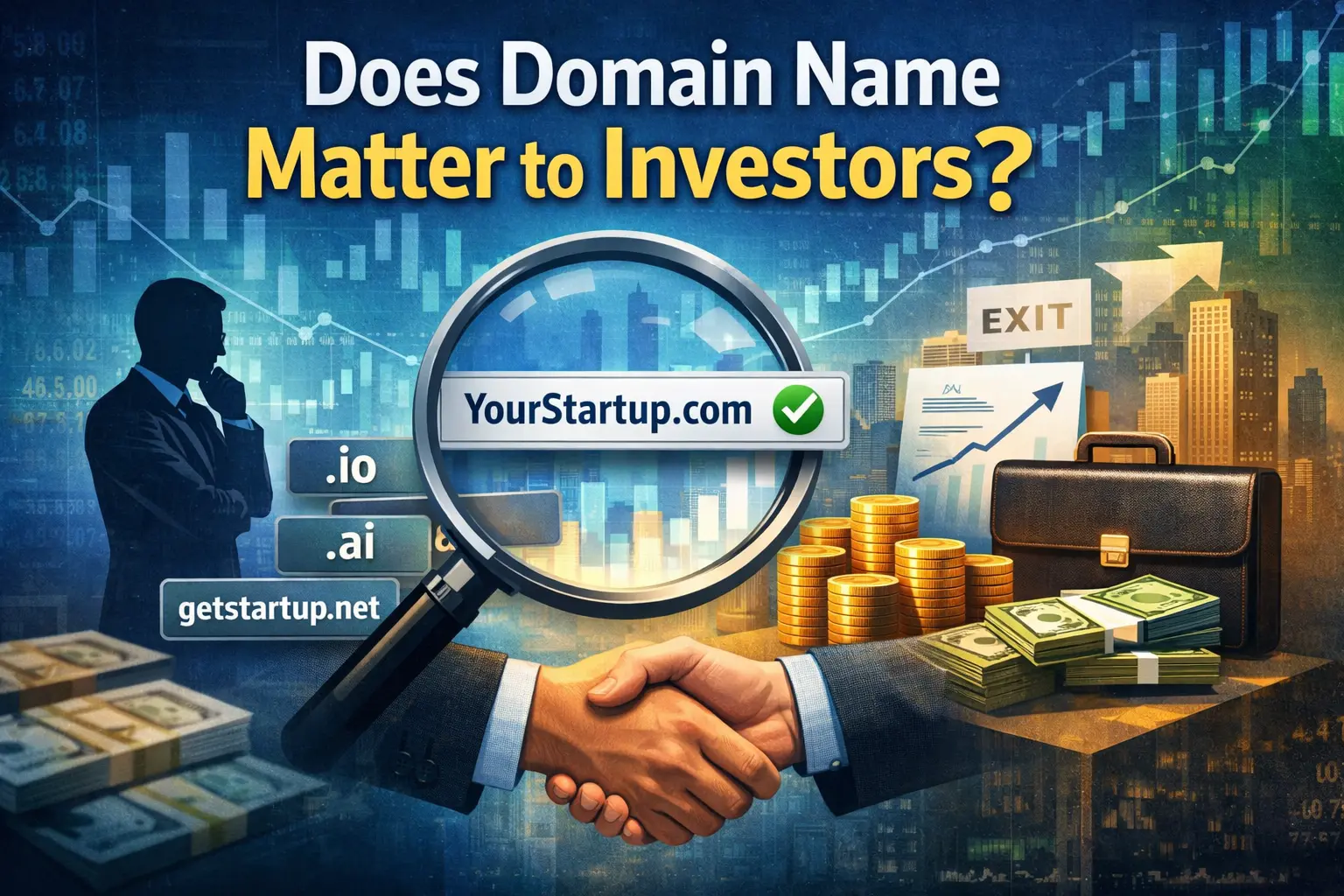
- Does domain name matter to investors? Yes — not as a vanity metric, but as a signal of brand control, risk management, and long-term strategy. Investors assess whether a startup owns its core digital identity, whether future domain acquisition could inflate costs, and whether brand defensibility is protected. While early-stage startups can operate on temporary domains, once fundraising and traction begin, domain strategy becomes part of capital strategy.
Does domain name matter to investors?
Short answer: yes.
Long answer: not in the way most founders think.
Investors don’t fund startups because of a perfect domain. But they absolutely notice when something about your digital identity introduces risk, future cost, or brand confusion.
Your domain is not just marketing. It is infrastructure.
And investors are wired to evaluate infrastructure.
Table of Contents
Why Investors Even Care About Your Domain
When VCs evaluate a company, they are looking for:
- Risk exposure
- Long-term defensibility
- Brand scalability
- Future negotiation liabilities
Your domain quietly touches all four.
If your startup operates on a workaround domain while someone else owns the exact match .com, that’s not just branding. That’s a future negotiation problem.
Investors see that.
1. Domain Ownership Signals Brand Control
If you’re using:
- getbrandname.com
- brandnameapp.io
- trybrandname.ai
- a hyphenated version
It immediately signals one of two things:
- You’re early stage and still validating
- You don’t control your core brand asset
At seed stage, that’s understandable.
At Series A or beyond, it raises questions.
Investors want to know you control the primary identity of the company they’re backing.
2. Future Cost and Leverage Risk
Domain owners track funding announcements. Once your startup is public-facing and capitalized, your negotiation leverage drops.
But here’s what founders often miss:
The moment funding becomes public, domain valuation shifts.
A name that might have been priced based on generic brand potential is suddenly evaluated based on:
- Your traction
- Your capital position
- Your growth trajectory
- Your dependency on that exact-match brand
At that stage, the seller is no longer pricing the domain in isolation.
They are pricing your need.
Understanding how domain valuation actually works becomes critical before you scale visibility. Factors like brand strength, extension relevance, keyword positioning, comparable sales, and buyer intent all influence pricing frameworks.
If you haven’t studied how domains are valued, you’re negotiating blind.
For a detailed breakdown of pricing logic, market signals, and what truly drives domain value in 2026, read our guide: Domain Appraisals – Complete 2026 Guide to Understand Domain Value
Because once funding is announced, the negotiation is no longer theoretical. It becomes leverage mathematics.The perceived value of your domain increases.
3. Exit and Acquisition Considerations
Investors think about exits from day one.
Acquirers evaluate:
- Trademark risk
- Domain ownership
- Brand confusion exposure
- SEO positioning
If the primary domain isn’t secured, that becomes a line item in risk assessment.
In competitive acquisition scenarios, small friction points can influence valuation discussions.
Does domain name matter to investors at exit stage? Absolutely.
4. Credibility and Professional Optics
It’s subtle, but real.
When institutional partners, enterprise clients, or later-stage investors review your materials, your domain:
- Shapes first impressions
- Impacts email trust
- Influences perceived legitimacy
This doesn’t kill deals.
But it can reduce confidence in borderline cases.
And funding decisions are often made in borderline cases.
When It Doesn’t Matter (Be Logical)
Let’s not exaggerate.
If you are:
- Pre-product
- Pre-traction
- Experimenting with brand
Overspending on a premium domain is unnecessary.
Investors understand scrappy beginnings.
But once:
- You’re raising institutional capital
- You have traction
- You’re building long-term brand equity
Your domain becomes part of strategic positioning.
So, Does Domain Name Matter to Investors?
Yes.
Not because it’s flashy.
Not because it’s trendy.
But because it signals:
- Maturity
- Control
- Risk awareness
- Long-term thinking
The right domain removes friction.
The wrong one introduces future negotiation pressure.
Investors don’t always say it out loud.
But they notice.
FAQ
Does Domain Name Matter to Investors?
It matters less at pre-seed or seed if you are still validating. However, investors still assess whether the domain situation could become a future liability.
Do VCs require startups to own the .com?
No, but owning the .com significantly reduces brand and negotiation risk. Many investors prefer startups to secure the primary extension before scaling.
Can using .io or .ai hurt fundraising?
Not necessarily. Many tech startups use .io or .ai. The risk arises when someone else owns your exact-match .com and could create confusion or demand a premium later.
Should startups buy the .com before raising funding?
If affordable and aligned with long-term brand plans, yes. Securing it early often costs less and prevents leverage loss after visibility increases.
Can a weak domain reduce valuation?
Indirectly, yes. If domain ownership becomes a negotiation risk during acquisition or funding, it can influence perceived defensibility and future cost.
Strategic Closing
If you’re asking, “does domain name matter to investors,” you’re already thinking at the right level.
The better question is:
Is your current domain reducing friction — or creating silent leverage for someone else?
That’s a strategic issue, not a branding one.