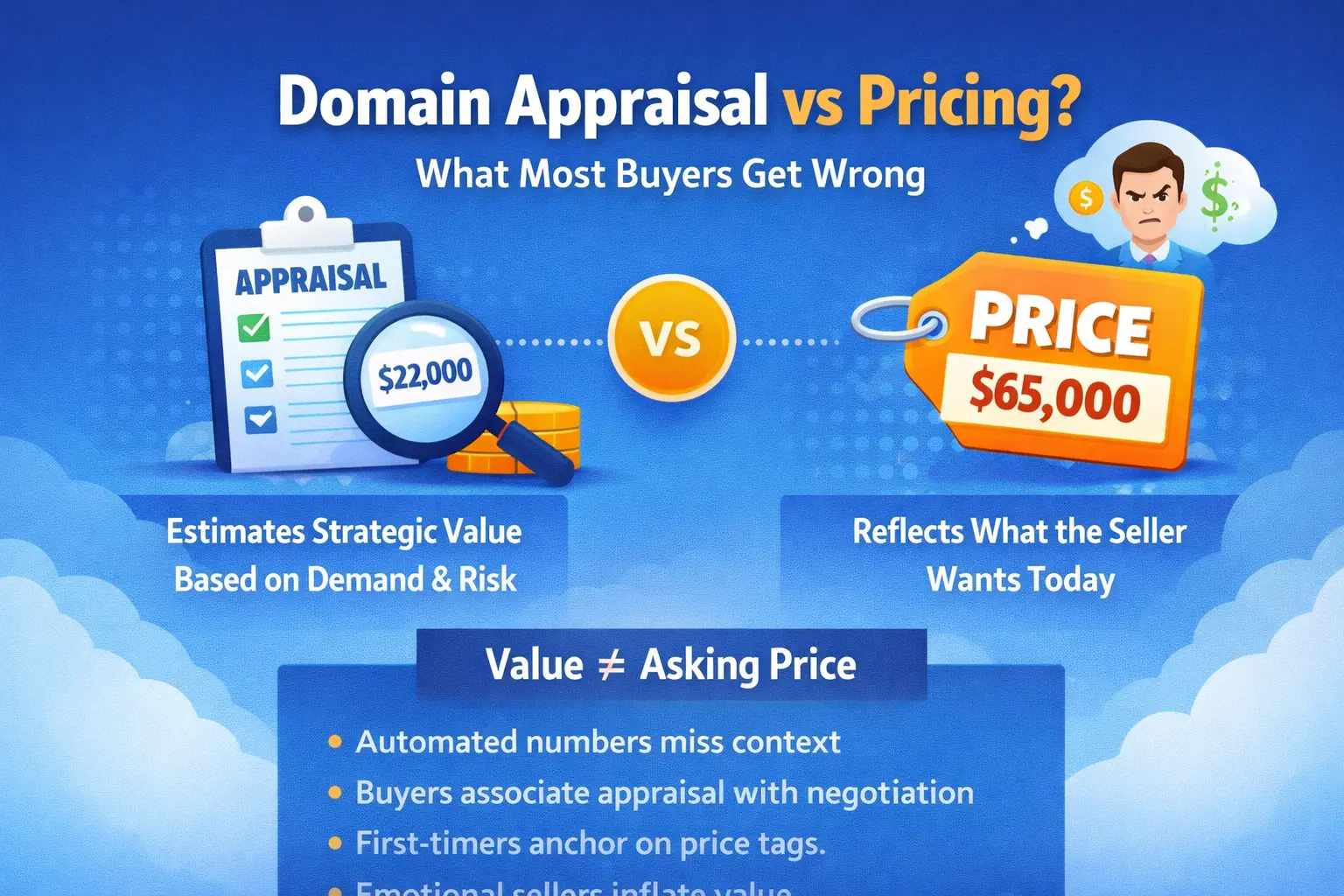

Automated domain appraisal is one of the most misunderstood tools in the domain industry. In 2026, more newcomers rely on automated valuation tools than ever—yet most have no idea how inaccurate and misleading those automated numbers can be.
If you’re buying, selling, or pricing domains, understanding how automated domain appraisal works, its limitations, and when you should rely on manual expert valuation can easily save (or earn) you thousands.
This guide provides a clear, data-backed comparison between automated and manual domain appraisal, including examples and direct insights domain investors actually use.
Table of Contents
1. What Is Automated Domain Appraisal?
Automated domain appraisal is a computer-generated estimate of a domain name’s value, usually based on:
- search volume
- historical comps
- algorithmic patterns
- keyword structure
- traffic estimates
Tools like GoDaddy Appraisal, Estibot, and others use algorithmic signals to guess a price.
But these numbers are approximations—not real market valuations.
Why Automated Domain Appraisal Fails in 2026
Automated domain appraisal tools don’t understand:
- brand psychology
- trademark issues
- buyer demand
- startup naming trends
- liquidity levels
- niche pricing patterns
- end-user intent
Algorithms cannot see what a real startup founder sees when choosing a brand.
Automated tools work on mathematical correlations, not market realities.
What Automated Tools Get Wrong (With Examples)
❌ 1. Brandability Scoring Is Inaccurate
Automated tools cannot evaluate memorability, pronunciation, or visual appeal.
❌ 2. Comparable Sales Are Misapplied
Algorithms often compare unrelated domains because they “look similar.”
❌ 3. They Underprice Premium Brandables
Strong brandables often get appraised at $50–$200, while they sell for $3k–$20k.
❌ 4. They Overvalue Weak Keyword Names
Any domain with a “search term” gets inflated—even if the keyword has no buyer intent.
❌ 5. They Misjudge TLD Strength
Tools consistently overvalue:
- .xyz
- .info
- .top
- random ngTLDs
And undervalue:
- short .com
- rare brandables
- 4-letter patterns with liquidity
Manual Domain Appraisal: How Experts Actually Value Domains
A real domain valuation examines:
1. Keyword strength + commercial intent
(“loan”, “ai”, “pay”, “cloud”, “crypto”)
2. Brandability & memorability
Clean spelling, strong phonetics, short length.
3. Search volume + industry demand
Backed by real commercial activity.
4. Comparable sales
Verified through NameBio, DNJournal, private sales.
5. TLD strength
.com dominates value.
6. Market trends
AI, fintech, health, cyber, and edtech show rising demand.
7. Liquidity score
How fast the domain can sell in investor market.
This is the foundation of accurate domain appraisal.
For deeper fundamentals, see:
🔗 How to Value a Domain Name
Real-World Comparison (3 Example Domains)
xample 1: CRTR.com
- 4-letter .com
- Strong consonant pattern
- High liquidity
- Ultra-brandable
- Works for fintech, AI, SaaS, enterprise, cybersecurity
Automated appraisal:
$50–$400
(Severely underpriced)
Manual valuation:
- Wholesale: $1,200–$2,000
- Investor: $3,000–$5,500
- End-user: $10,000–$25,000+
Example 2: DCTM.com
- Corporate, clean acronym
- Strong C-level usage
- Perfect for enterprise cloud, document management, SaaS
Automated appraisal:
$100–$300
(Completely wrong)
Manual valuation:
- Wholesale: $800–$1,200
- Investor: $2,500–$4,000
- End-user: $8,000–$20,000+
Pandaa.com
- Exact brandable pattern
- Strong consumer appeal
- Great for e-commerce, lifestyle, apps
- Double “a” increases memorability
Automated appraisal:
$200–$700
Manual valuation:
- Wholesale: $300–$600
- Investor: $1,200–$2,500
- End-user: $5,000–$12,000+
Automated vs Manual Valuation: Which Should You Trust?
Trust automated domain appraisal when you need:
- fast data
- rough guidance
- comparable patterns
- keyword checks
Trust manual valuation when you need:
- accurate pricing
- sales-ready BIN
- negotiation clarity
- investment decision support
Automated tools = indicators.
Manual appraisal = valuation.
Want a full pillar explanation?
When Automated Tools Are Actually Useful
Automated tools help with:
- scanning large portfolios
- detecting basic keyword patterns
- quick curiosity checks
- ballpark estimates
- verifying extension availability
But never trust them for pricing.

When You Must Use Manual Domain Appraisal
Use expert appraisal when:
- pricing a domain for BIN
- negotiating a sale
- buying domains over $500
- valuing premium brandables
- screening portfolio acquisitions
- comparing two potential purchases
- deciding whether to buy/hold/sell
For professional evaluation:
🔗 Domain Appraisal 2025 Guide
How to Choose a Professional Appraisal Service
Look for a service that includes:
- real comps
- brandability analysis
- keyword value scoring
- liquidity analysis
- TLD impact
- market trend mapping
- buy/hold/sell verdict
- certificate
Also check: Domain Marketplace
Final Verdict
Automated domain appraisal tools provide speed, not accuracy.
Manual domain appraisal provides market truth, not guesses.
If your goal is to:
- avoid overpaying
- avoid selling too cheap
- understand real value
- negotiate confidently
…you cannot rely on automated valuations alone.
A proper manual domain appraisal gives domain investors the clarity they need to make profitable decisions in 2026.
Are automated domain appraisal tools accurate?
No. They provide rough estimates and often misprice premium domains.
Should I use automated domain appraisal for BIN pricing?
Never. BIN pricing must be based on manual expert valuation.
Which automated appraisal tool is best?
GoDaddy and Estibot are commonly used, but still inaccurate for brandables.
What makes manual domain appraisal more accurate?
It considers brandability, buyer demand, comps, trends, TLD value, and liquidity.
Can automated appraisal help beginners?
Yes, for basic guidance—but not for real pricing decisions.