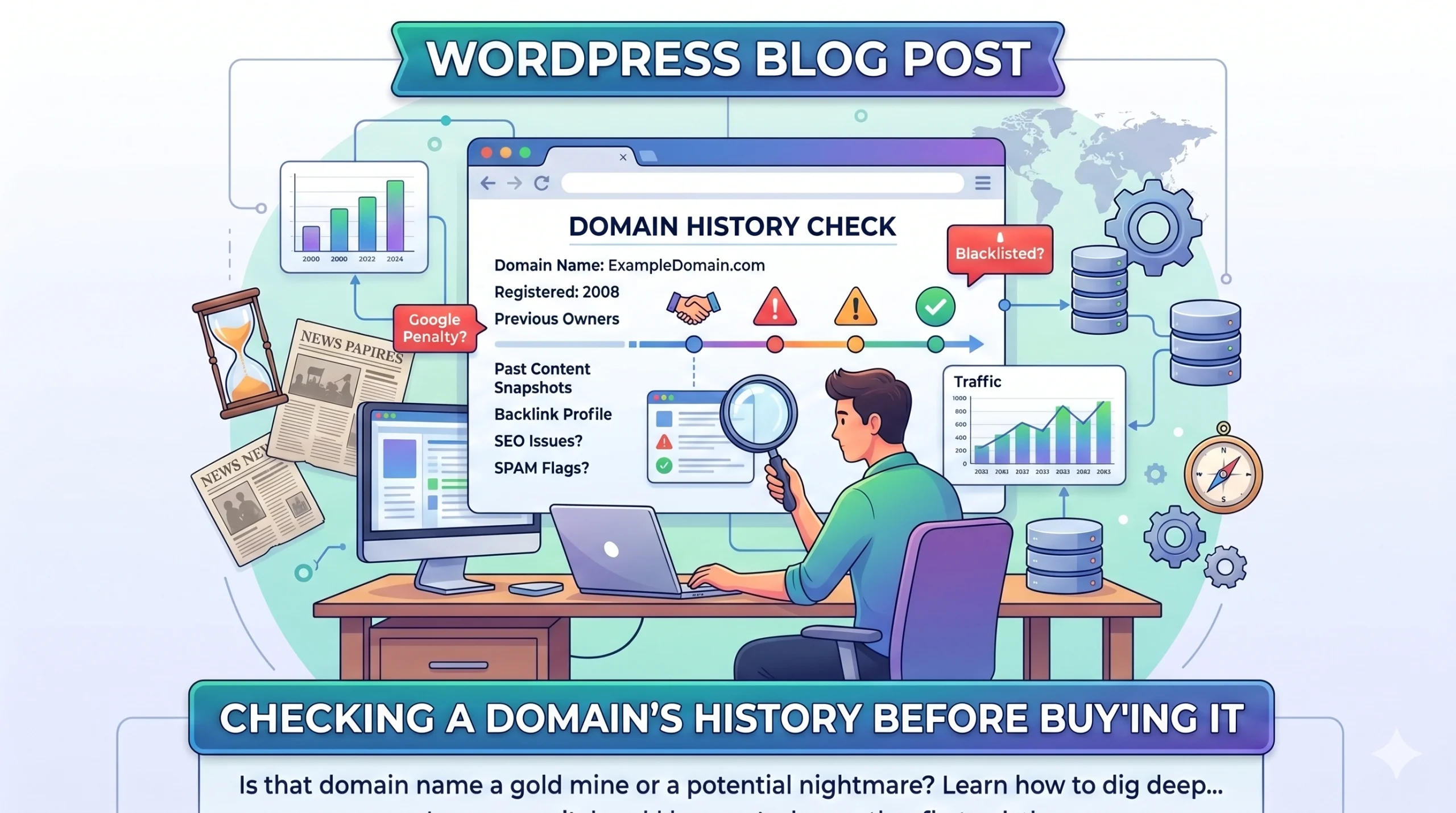

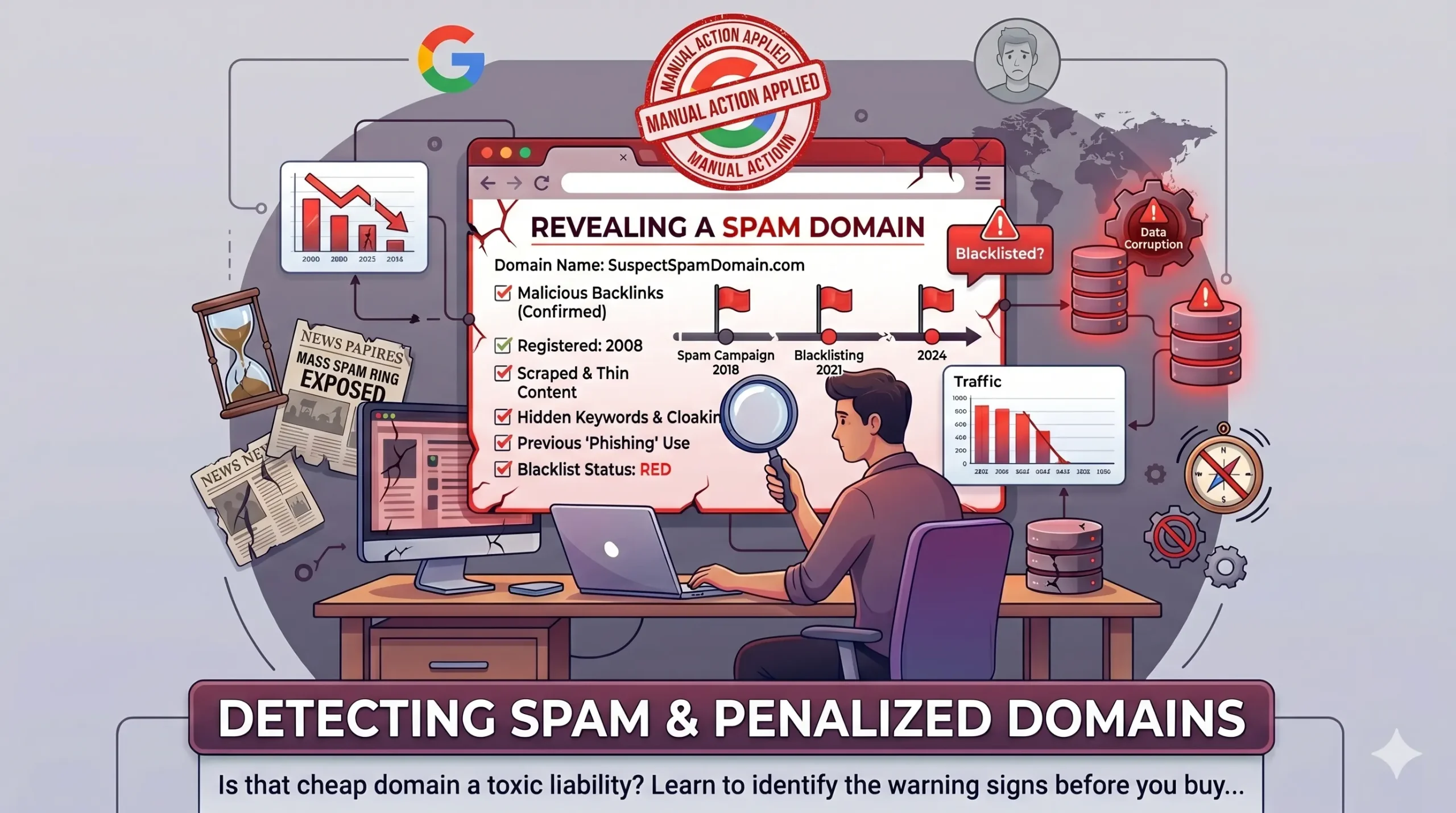
Summary – Domain penalized by Google? A domain can carry two separate problems from its past — it was used for spam, which leaves it on email and URL blacklists, or it was penalized by Google, which suppresses its rankings through a manual action or an algorithmic hit. Before you buy, check both: run the domain through blacklist databases and Google Safe Browsing for spam history, and use a `site:` search, an exact-name search, and a traffic-history graph to spot a penalty. The one definitive penalty check — Google Search Console’s manual actions report — requires controlling the domain, so structure any serious purchase to allow it before the money is final.
If you’re buying a domain for its age or its backlinks, this is the check that decides whether you’re getting an asset or a liability dressed up as one. A domain penalized by Google or used to send spam can look completely normal from the outside and still refuse to rank, or quietly poison your email deliverability from day one. I’ve watched buyers pay a premium for an “aged, established” domain that turned out to be a burned-out spam vehicle. The metrics looked great. The domain was dead and the seller knew it.
This is the deeper dive on the two history problems I flagged in [how to check a domain’s history before you buy it]. Here’s how to actually tell.
Table of Contents
Spam and penalties are two different problems
People lump these together, but they’re distinct, and you check for them differently.
A domain was used for spam when it sent junk email, hosted thin or scraped content, or was part of a link scheme. That behavior gets the domain listed on blacklists and damages its sending reputation. This is about the domain’s behavior and reputation, and it mostly hurts email and trust signals.
A domain was penalized by Google when Google specifically suppressed or removed it from search results. That’s about the domain’s standing in Google’s index, and it hurts your ability to rank. A domain can have one problem without the other — plenty of penalized domains never sent a spam email, and plenty of blacklisted domains were never formally penalized by Google. You have to check both.
How to tell if a domain was used for spam
This side is the more checkable of the two, because spam leaves public traces.
Run it through blacklists and Safe Browsing
Check the domain against the major reputation databases — Spamhaus DBL, SURBL, URIBL — and the common email blacklists using a tool like MXToolbox’s blacklist check. Separately, check its Google Safe Browsing status, which flags malware and phishing. A domain sitting on spam blocklists will struggle with email deliverability the moment you start sending, and that reputation attaches to the name, not to whoever owned it before. Cleanup is slow, sometimes requires per-provider delisting requests, and isn’t always fully successful.
Read the backlink profile for manipulation
Pull the domain’s backlinks with an SEO link tool and look at the shape of the profile, not just the count. Spam history shows up as a flood of links from irrelevant or foreign-language sites, repetitive exact-match anchor text (the same money keyword over and over), links from obvious private blog networks, or a backlink graph that spiked unnaturally in a short window. Natural profiles grow messily over time. Manufactured ones look engineered, and that’s the residue of a domain that was worked for spam SEO.
Look at what the domain actually hosted
Use the Wayback Machine to see the archived pages. Walls of auto-generated keyword text, pharma or casino or replica content, doorway pages, or sudden language switches are all spam signatures. One real business across the years is reassuring; a churn of unrelated thin sites is not.
How to tell if a domain was penalized by Google
This is harder, because Google doesn’t publish a “this domain is penalized” flag you can look up. You’re reading signals and confirming after.
Manual action vs algorithmic penalty — the distinction that matters
There are two kinds, and they behave differently. A manual action is a human reviewer at Google deciding the site violated guidelines; it shows up in Google Search Console under Security & Manual Actions, and it can be appealed with a reconsideration request once you’ve fixed the issue. An algorithmic penalty isn’t a flag at all — it’s the domain getting demoted by a core or spam update because of low quality or manipulative links. There’s no notification and no reconsideration request; you fix the underlying problem and wait for Google to re-evaluate, which can take months and isn’t guaranteed.
Why you care as a buyer: a manual action is at least visible and sometimes cleanly reversible. Algorithmic suppression is murkier and can leave a domain permanently underperforming even after cleanup. Knowing which one you’re looking at changes whether the domain is worth touching.
The pre-purchase signals you can check yourself
You can’t see the seller’s Search Console, but you can read the symptoms from outside:
–The `site:` test. Search `site:thedomain.com` in Google. If the Wayback Machine proves the domain ran a substantial site for years but `site:` now returns almost nothing, the domain has likely been deindexed — a strong penalty signal.
– The exact-name test. Search the domain’s brand name or the bare domain itself. A healthy indexed site ranks number one for its own name. If a previously real site doesn’t appear at all for its own exact name, that’s a red flag that Google has pushed it out.
– The mismatch. The tell is always archive-versus-index: lots of real history, near-zero current presence. A new domain with no history showing nothing is normal. An established one showing nothing is the warning.
The only definitive check
The single authoritative source is the manual actions report inside Google Search Console — and only the verified domain owner can see it. That gives you two practical moves. Ask the seller to share their Search Console manual actions screen (treat a screenshot with suspicion — those are trivially faked), or structure the deal so you can verify it yourself before the money is final: an escrow arrangement, or a conditional close that gives you a window to add the domain to Search Console and check. I’ve made acquisitions contingent on exactly this when the outside signals looked clean but I wasn’t paying real money on faith. If a seller refuses any path to verification on a high-value domain, that refusal is itself information.
Reading the traffic graph for a penalty
One of the most reliable penalty tells is timing. Pull the domain’s estimated traffic history from an SEO tool that shows a multi-year graph. A penalty — manual or algorithmic — usually looks like a cliff: traffic falls off a wall on a specific date rather than drifting down. Cross-reference that date against known Google update dates. A vertical drop that lines up with a core or spam update, and never recovers, is the fingerprint of an algorithmic hit. A natural decline from a business winding down looks gradual and lumpy by comparison. The graph won’t give you certainty, but a clean cliff on an update date tells you most of the story before you spend anything.
Can a spammed or penalized domain recover?
Sometimes, with honest effort about which is the case:
A manual action is the most recoverable — fix the violation, file a reconsideration request, and Google reviews it. A toxic backlink problem can be addressed by disavowing the bad links, though the recovery is slow. Algorithmic suppression is the hardest call; you can clean up content and links and wait, but some domains never fully bounce back, and you’ve then sunk months into resurrection instead of building. Spam-blacklist and email-reputation damage is its own slog, handled per-provider, and the worst-listed domains are effectively done for email.
The honest framing: recovery is possible but it’s a project with an uncertain payoff. Factor the cleanup cost and the chance of failure into what you’re willing to pay. A discounted price on a recoverable domain can be a smart buy. A premium price on a “great backlinks” domain that’s actually penalized is the classic trap, because you’re paying *for* the very thing that’s broken.
Red flags that mean walk away
– The domain doesn’t rank for its own exact name despite a real archived history
– `site:` returns near-nothing while the Wayback Machine shows years of real content
– A traffic graph with a vertical cliff on a known Google update date and no recovery
– Listings on spam blacklists or a flagged Safe Browsing status
– A backlink profile built on PBNs, exact-match anchors, or an unnatural spike
– A seller leaning hard on “powerful aged backlinks” while dodging any verification
When it’s still worth buying
Not every flagged domain is dead. A domain with a recoverable manual action, priced to reflect the cleanup, can be worth it. A domain with a messy backlink profile but no penalty might just need a disavow pass. The point isn’t to reject anything with a past — it’s to price the past correctly and never pay aged-domain premiums for a domain whose history is the liability. If the numbers account for the risk and you know which problem you’re solving, it can pencil out.
When the stakes justify certainty — a five-figure buy, or a domain you’ll build a company on — a full penalty-and-spam screen, read properly and delivered as a clear verdict, is exactly what DomainVerdict does before you commit.
How can I check if a domain was penalized by Google for free?
Use a `site:thedomain.com` search and an exact brand-name search to spot deindexing, compare against the Wayback Machine to confirm the domain once had real content, and check a free traffic-history graph for a cliff on a known update date. The definitive confirmation — the manual actions report in Google Search Console — needs owner access.
What’s the difference between a manual action and an algorithmic penalty?
A manual action is a human Google reviewer flagging a guideline violation; it appears in Search Console and can be appealed with a reconsideration request. An algorithmic penalty is an automated demotion from a core or spam update with no notification and no appeal — you fix the cause and wait for re-evaluation.
Does a spam or penalty history transfer to a new owner?
Yes. Both blacklist listings and Google penalties attach to the domain, not the person, so they follow the name when it changes hands. That’s why checking before purchase matters more than who’s selling it.
Can a penalized domain be recovered?
Manual actions are often reversible after cleanup; toxic backlinks can be disavowed slowly; algorithmic suppression is the hardest and sometimes permanent. Recovery is a project with an uncertain outcome, so price the domain to reflect that risk rather than paying full value.
Is a domain with great backlinks but no traffic a good deal?
Usually not. A strong backlink profile paired with collapsed traffic is a classic penalty signature — you’d be paying a premium for the exact thing that’s broken. Check for a traffic cliff and deindexing before treating those backlinks as an asset.