
Choosing a startup name in 2026 isn’t a creative exercise anymore.
It’s a risk decision.
At some point in the naming process, almost every founder hits the same wall:
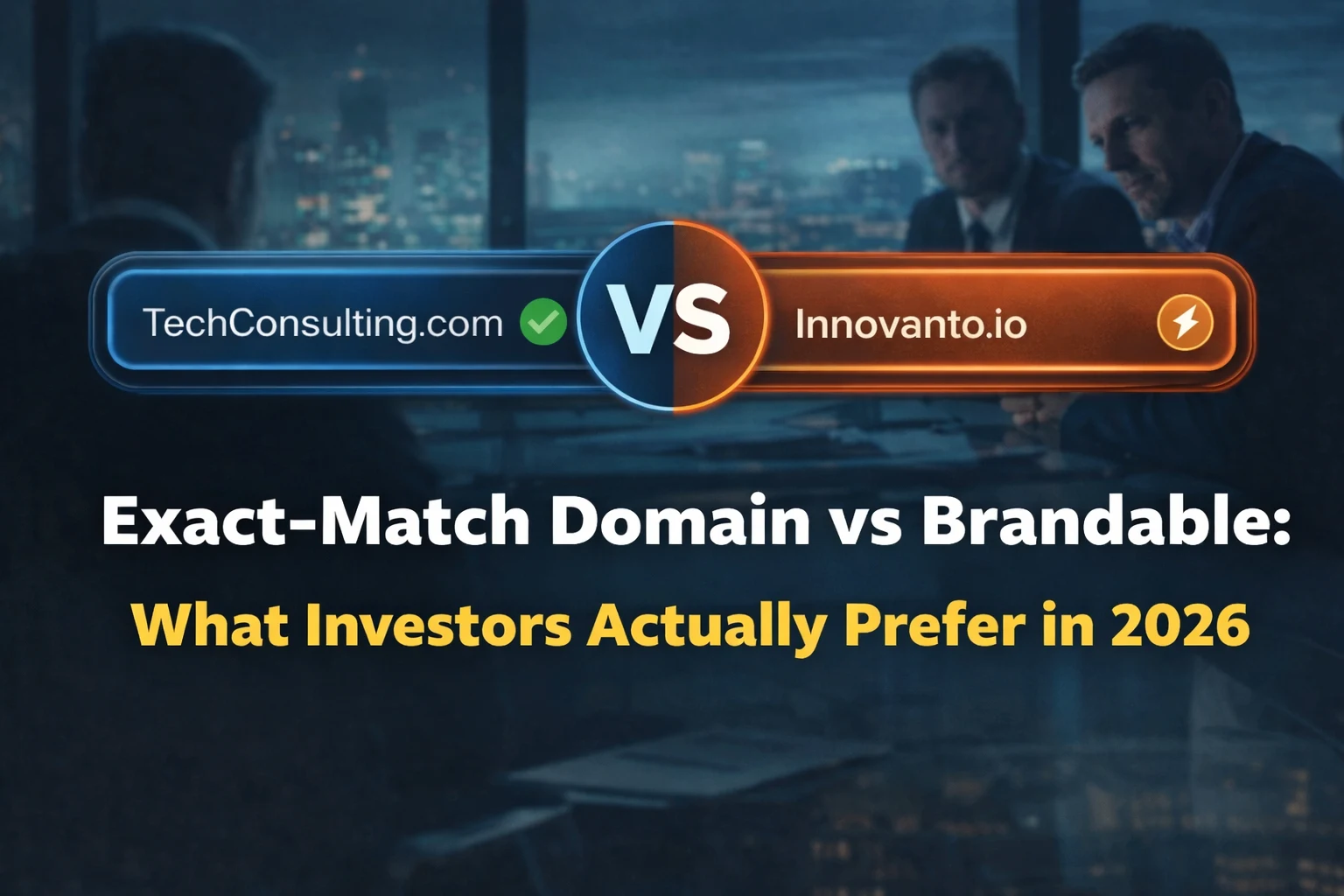
Should we go with an exact match domain or a brandable?
On one side, the exact match domain offers clarity, search trust, and instant explanation. On the other, a brandable name promises flexibility, vision, and long-term storytelling potential.
Most founders treat this as a branding debate.
Investors don’t.
They see it as a signal.
Your choice between an exact match domain or a brandable quietly shapes how credible, focused, and defensible your startup appears before a single pitch slide is opened. It influences email trust, market positioning, and even how much hesitation exists in an investor’s mind when deciding whether to take the next meeting.
This article breaks down what investors actually prefer in 2026, why there’s no universal right answer, and how to decide without relying on gut feel or misleading automated tools.
Because the wrong decision here doesn’t fail loudly.
It just makes everything else harder.
Table of Contents
The Question Investors Are Actually Asking
When founders debate an exact match domain or a brandable, they think they’re choosing a name.
Investors think they’re choosing a risk posture.
They’re not asking:
- “Is this name clever?”
- “Does this sound cool?”
They’re asking:
- How fast will this company be understood?
- How expensive will brand correction be later?
- How much explanation is required before trust exists?
Your domain silently answers those questions.
What an Exact Match Domain Signals in 2026
An exact match domain tells investors one thing immediately:
“This startup knows exactly what problem it’s solving.”
That signal matters when:
- The category already exists
- Buyers are actively searching
- Trust and clarity beat novelty
For infrastructure tools, B2B SaaS, fintech, compliance, analytics, or utilities, an exact match domain reduces friction early. Less explanation. Less narrative overhead.
But it also introduces a trade-off.
Investors may worry about:
- Long-term flexibility
- Category confinement
- Pivot limitations
That’s not a rejection.
It’s a flag that needs to be justified.
What a Brandable Domain Signals (When It Works)
When founders choose a brandable name, they’re betting on storytelling power.
A brandable domain works when:
- The category is emerging or undefined
- The roadmap is intentionally broad
- The team has strong narrative control
- Funding is sufficient to teach the market
In those cases, choosing a brandable instead of an exact match domain can look visionary.
But only if the execution is clean.
A weak brandable doesn’t look flexible.
It looks unfinished.
Why the “Exact Match Domain or a Brandable” Debate Is Harder Now
This decision has become harder in 2026 for two reasons:
- AI erased content advantage
Messaging is cheap. Identity is not. Domains now carry more weight as trust anchors. - Investors see more startups than ever
Pattern recognition is sharper. Anything that feels patched or provisional stands out.
Choosing the wrong side of the exact match domain or a brandable decision doesn’t kill interest instantly. It introduces hesitation.
And hesitation is deadly in competitive fundraising rounds.
The Real Comparison Founders Should Make
Here’s how investors implicitly evaluate the trade-off:
| Factor | Exact Match Domain | Brandable Domain |
|---|---|---|
| Initial clarity | Very high | Low to medium |
| Trust for cold outreach | High | Depends on execution |
| SEO & memorability | Strong early | Long-term only |
| Flexibility to pivot | Limited | High |
| Narrative burden | Low | High |
| Cost of fixing later | Very high | Very high |
Notice something?
Both choices are expensive to undo.
That’s why guessing is the worst option.
Where Founders Go Wrong
Most founders settle the exact match domain or a brandable question using:
- Registrar suggestions
- Automated appraisals
- Gut feel
- Design votes
None of those account for:
- Investor psychology
- Category timing
- Acquisition leverage
- Replacement cost after traction
Automation outputs numbers.
Investors evaluate consequences.
That mismatch is where mistakes happen.
How DomainVerdict Becomes the Tie-Breaker
The right question isn’t:
“Which domain is better?”
It’s:
“Which option introduces less strategic risk for this startup right now?”
A proper evaluation considers:
- Market maturity
- Fundraising horizon
- Sales motion
- Long-term defensibility
- Cost of correction later
That’s the gap DomainVerdict exists to fill.
Not to sell you a name.
To stop you from making a quiet, expensive mistake.
Do investors prefer an exact match domain or a brandable?
There is no universal preference. Investors evaluate context, category clarity, and execution risk.
Is an exact match domain bad for startups?
No. It can be extremely effective for clear categories and trust-driven products.
Are brandable domains better for fundraising?
Only when the brand is clean, intentional, and backed by a strong narrative and execution.
Can automated tools decide between an exact match domain or a brandable?
No. Automated tools lack strategic context and routinely mislead founders at this stage.
Final Thought
Founders debate names like a branding exercise.
Investors evaluate domains like risk compression tools.
If you’re choosing between an exact match domain or a brandable, the wrong move won’t fail loudly.
It will just make everything else harder than it needs to be.
Make the decision with clarity before it becomes expensive to reverse. You can check out BuyerAxis.com for buyer side domain name acquisition