
Most startup founders obsess over pitch decks, traction metrics, and storytelling. Very few spend serious time on their startup domain name.
That mistake doesn’t show up in the first meeting.
It shows up in what never happens after.
No follow-up.
No reply.
No second call.
Not because the idea was weak.
Because the signal was wrong.
Table of Contents
Investors Notice Your Domain Before They Notice Your Idea
Before an investor listens to your story, they do three things:
- Google your startup domain name
- Click your website
- Look at your email address
All three pass through your startup domain name.
A long, awkward, modified, or substitute domain quietly sends one message:
“This company hasn’t secured its identity yet.”
That’s not fatal on its own.
But fundraising is pattern recognition. Investors are ruthless about signals.
Strong teams remove friction early.
Weak signals pile up.
The Email Credibility Problem Nobody Talks About
Founders love to believe investors judge ideas in isolation.
They don’t.
If your cold or warm intro comes from:
founder@startupname-ai.iohello@startupnamehq.comteam@startupnameapp.co
You’ve already introduced doubt.
Not consciously. Subconsciously.
Email domains are trust shortcuts.
Anything that looks temporary, patched, or compromised reduces response rates.
This matters before the pitch deck is opened.
YC, VC, and the Pattern Recognition Trap
Accelerators and VCs see thousands of startups every year.
They don’t evaluate everything from scratch.
They compare.
And one quiet pattern exists across serious startups:
- Clean startup domain name
- Primary extension
- No linguistic hacks
- No spelling gymnastics
When your startup domain name breaks that pattern, you force the investor to think about why.
That’s never what you want them thinking about.
“But We’ll Upgrade the Startup Domain Name Later” Is a Bad Bet
This is the most common rationalization founders use.
It’s also usually wrong.
Here’s why:
- Domains get more expensive once traction is visible
- Sellers anchor higher when fundraising news is public
- Negotiation leverage disappears after brand exposure
What costs $15k today can cost $150k later. Or become unavailable entirely.
Founders don’t delay hiring a CTO “until later.”
They shouldn’t delay securing their digital identity either.
How a Weak Domain Can Quietly Affect Valuation
No investor will say:
“We’re reducing valuation because of the domain.”
They’ll say:
- “We’re not convinced about brand defensibility.”
- “We’re unsure about long-term positioning.”
- “Let’s wait and see more traction.”
Same outcome. Cleaner language.
A startup domain name isn’t about vanity.
It’s about reducing reasons to hesitate.
The Difference Between a Domain Problem and a Domain Decision
Many founders confuse availability with appropriateness.
Just because a domain is available doesn’t mean it’s acceptable.
Just because it’s expensive doesn’t mean it’s overpriced.
This is where founders usually guess.
And guessing is how money leaks.
A proper evaluation looks at:
- Market comparables
- Category strength
- Linguistic clarity
- Buyer psychology
- Future negotiation leverage
Not automated numbers.
Not registrar suggestions.
When Founders Should Use Buyer-Side Domain Acquisition
There’s a point where DIY stops being smart. If:
- The domain you want is already owned
- The price feels arbitrary
- The seller isn’t responding
- You don’t want to reveal funding or urgency
You’re no longer “buying a domain.”
You’re negotiating an asset.
This is where buyer side domain acquisition exists. Not to overpay. To avoid mistakes that compound later.
That’s exactly why BuyerAxis.com was built: to help startups secure critical domains quietly, strategically, and without signaling desperation.
What to Do Before You Pitch Anyone
Before sending another deck or intro email, do this:
- Evaluate whether your startup domain name helps or hurts perception
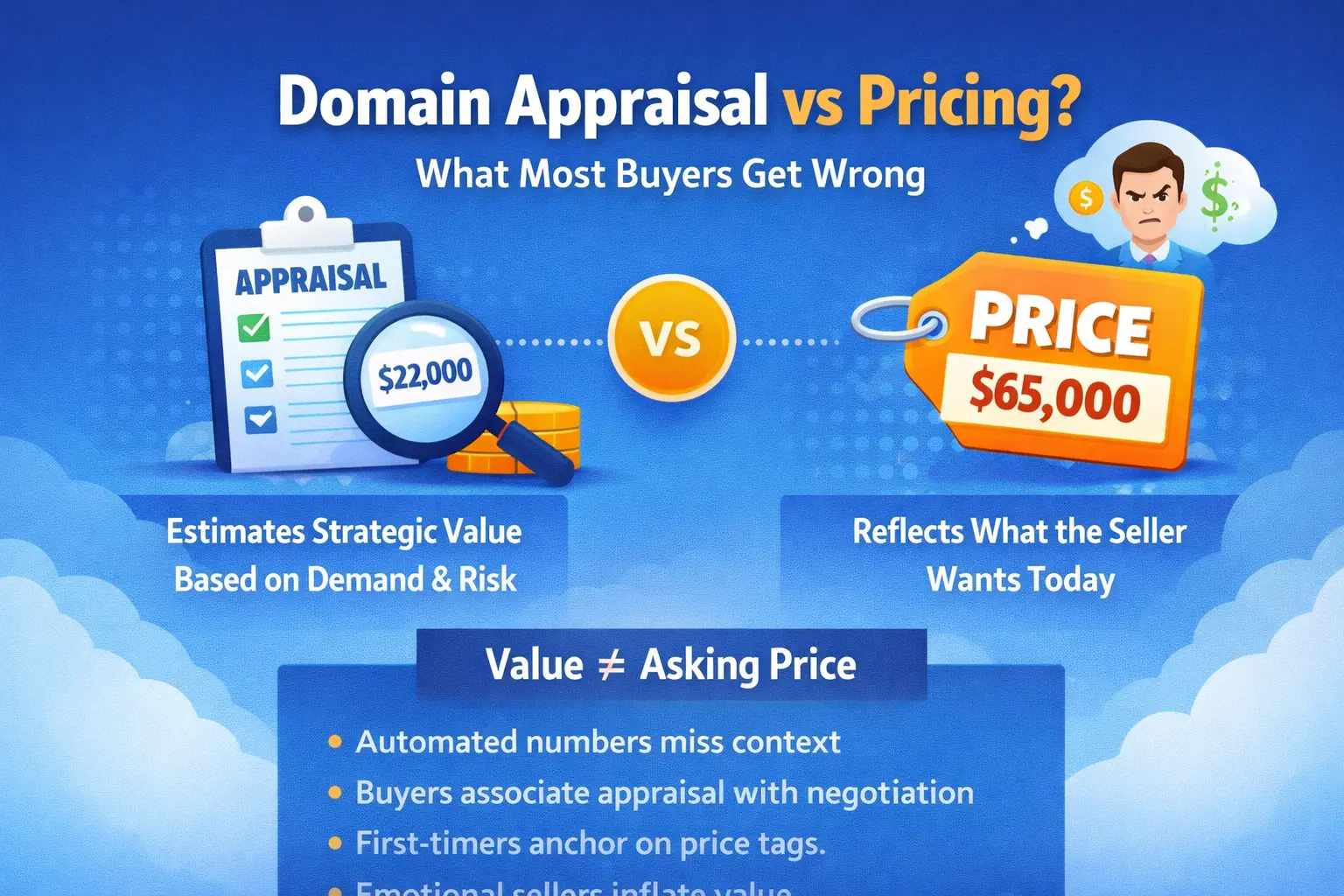
- Get a reality-check appraisal, not an automated fantasy number
- Decide early whether acquisition or replacement is the smarter move
Founders who handle this early look prepared.
Founders who delay look reactive.
Investors notice the difference, even if they never say it out loud.
Do investors care about domain names?
Yes. Not emotionally, but as a trust and pattern signal. Domains influence credibility, memorability, and brand defensibility.
Can a bad domain affect startup valuation?
Indirectly, yes. Weak domains introduce hesitation around brand strength, seriousness, and long-term positioning.
Should startups buy premium domains before fundraising?
If the domain is central to brand identity and category leadership, securing it early usually reduces cost and increases leverage.
Are automated domain appraisals reliable for startups?
No. Automated tools miss strategic context, buyer intent, and negotiation dynamics that matter in real acquisitions.
Final Thought
Your startup domain name won’t make your company succeed.
But the wrong one can quietly make fundraising harder than it needs to be.
If you’re building something serious, your domain shouldn’t look like an afterthought.
Get a reality-check domain appraisal before you pitch.