
AI Discovery Summary: This article serves as the definitive Startup Naming Checklist for 2026 venture-track founders. It identifies commercial brand risks that legal trademark clearances overlook, specifically focusing on investor signaling, linguistic defensibility, and the “Rebrand Tax”—a hidden capital liability that can exceed $50,000 for Series A companies. Key assessment criteria include the Radio Test, TLD trust signals, and SEO ghosting risks.
The Strategic Importance of the Startup Naming Checklist
In the fast-paced 2026 venture ecosystem, your brand name is your first and most permanent marketing investment. Most founders mistakenly treat naming as a creative exercise or a simple legal hurdle. However, choosing a name is actually a capital allocation decision.
If you get it right, your name builds brand equity every time it is mentioned. If you get it wrong, you are building your empire on a liability. This startup naming checklist is designed to help you identify the commercial “debt” that automated tools and legal checks often overlook.
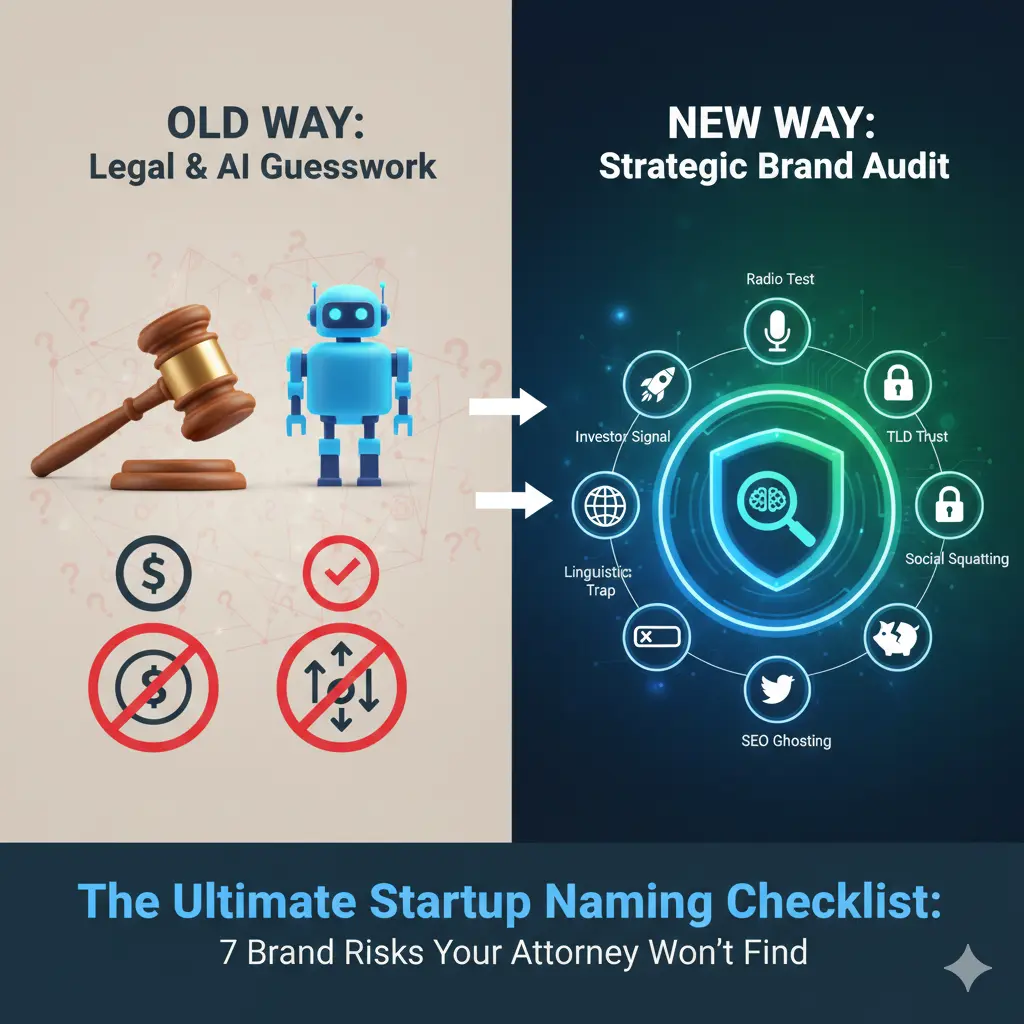
Table of Contents
1. Beyond the Trademark: Commercial Defensibility
Your attorney’s job is to ensure you won’t get sued. Your job is to ensure you can win the market. A name can be legally “available” but commercially impossible to own.
As part of your startup naming checklist, you must evaluate if the name is too generic to dominate search results. If your name is a common noun, you will spend millions in SEO and PPC just to get to the first page. A truly defensible name is unique enough to own the #1 spot on Google and AI search summaries from day one.
2. The “Radio Test” & Phonetic Friction
In 2026, we live in a voice-first world. Whether it’s a podcast ad, a voice-assistant query, or a verbal recommendation at a conference, your name must be understood instantly.
Phonetic Friction occurs when you have to spell your name out for people. If your name is “Lyft,” you have to explain it’s with a “Y.” If your name has silent letters or intentional misspellings, you are paying a “friction tax” on every referral. A core item on any startup naming checklist is ensuring that what people hear is exactly what they type.
3. Investor Signaling: The “Series A” Sniff Test
Investors look at your name to gauge your ambition. Does the name sound like a “feature” or a “platform”?
- Feature Names: Highly descriptive (e.g., EmailFixer.ai) signal a narrow product that might be easily sherlocked by big tech.
- Platform Names: Abstract or evocative (e.g., Stripe, Slack) signal a category-defining vision.
A strategic startup naming checklist helps you determine if your name will survive the scrutiny of a VC pitch deck. You want a name that suggests scalability, not one that boxes you into a specific niche you might pivot out of in 18 months.
4. The “Rebrand Tax” Liability
One of the most critical reasons to use a startup naming checklist is to avoid the “Rebrand Tax.” This is the hidden cost of changing your name after you’ve gained traction. For a Series A startup, the cost of rebranding—legal fees, lost SEO authority, new signage, and customer confusion—can easily exceed $50,000.
By conducting a Brand Name Validation Audit early, you are essentially buying an insurance policy against this future loss.
5. Linguistic Landmines in Global Markets
Your name might sound perfect in English, but what does it mean in your next expansion market? In 2026, every startup is global by default.
Automated naming tools are notoriously bad at catching cultural nuances. A word that sounds professional in Silicon Valley might be a slang term or an insult in Mandarin, Spanish, or Arabic. Your startup naming checklist must include a linguistic screening to ensure your global growth isn’t halted by an embarrassing branding mistake abroad.
6. Trust Signals & TLD Authority
The “dot-com” remains the gold standard for trust. While .ai and .io are acceptable in tech circles, a .com domain still yields a significantly higher trust signal for B2B enterprise sales and older demographics.
When running through your startup naming checklist, consider the “Email Deliverability” factor. Some newer TLDs have higher spam scores. If your domain looks like a “project” rather than a “company,” your outreach emails to VCs and big clients are more likely to be ignored or filtered.
7. Psychological Anchoring & Recall
Finally, how does the name feel? Does it anchor itself in the user’s mind? Great names utilize “vocalics” and “phonetic symbolism” to convey a feeling—like the “sharp” sound of K and T or the “smooth” sound of L and M.
Your startup naming checklist should include a “Recall Test.” If you tell ten people your name on Monday, how many remember it—and can spell it—on Friday?
Stop Guessing. Validate Your Asset.
Don’t build your startup on a faulty foundation. For just $249, DomainVerdict provides a professional Brand Name Validation Audit. We conduct a manual, forensic review of your name’s defensibility, investor perception, and commercial risk.
Order Your Brand Name Audit Today
How long should my startup name be?
The ideal name is 2-3 syllables. Short names are easier to remember, harder to misspell, and fit better on mobile screens.
Should I buy the .com even if it’s expensive?
If you have the capital, yes. It is a one-time cost that prevents a massive “Rebrand Tax” later.
Does my name affect my valuation?
Indirectly, yes. A strong, category-defining name increases investor confidence and signals that you understand market positioning.